Case study / 01
Riderr
A logistics platform connecting customers, riders and logistics companies — mobile, web, backend and infrastructure.
- Category
- Platform
- Role
- Co-founder & Software Engineer
- Status
- Live
Overview
Riderr is a Nigerian logistics platform that brings customers, riders and logistics companies onto one system: instant delivery requests, smart rider matching, upfront pricing and live GPS tracking from pickup to drop-off, with a dashboard for partner companies to manage their fleets. As a co-founder and engineer I built across the whole product — the mobile app, the web frontend and the backend — and I own how it is deployed and run.
The problem
Businesses struggle to find dependable delivery, while capable riders have no unified marketplace. Logistics companies manage riders with phone calls and spreadsheets, and customers get no visibility into where their package is or what it will cost.
Approach
- Mobile app in React Native with Expo — one codebase for iOS and Android: request a delivery, see the price upfront and follow the rider on a map.
- Website and partner dashboard in Next.js, where logistics companies manage riders, deliveries and performance.
- REST API in NestJS and Express on Node.js, backed by MongoDB, handling rider matching, pricing by distance and availability, and the delivery lifecycle.
- Live tracking by polling: the app sends the rider's GPS position to the API and customers' screens fetch the latest location at a short interval.
Architecture
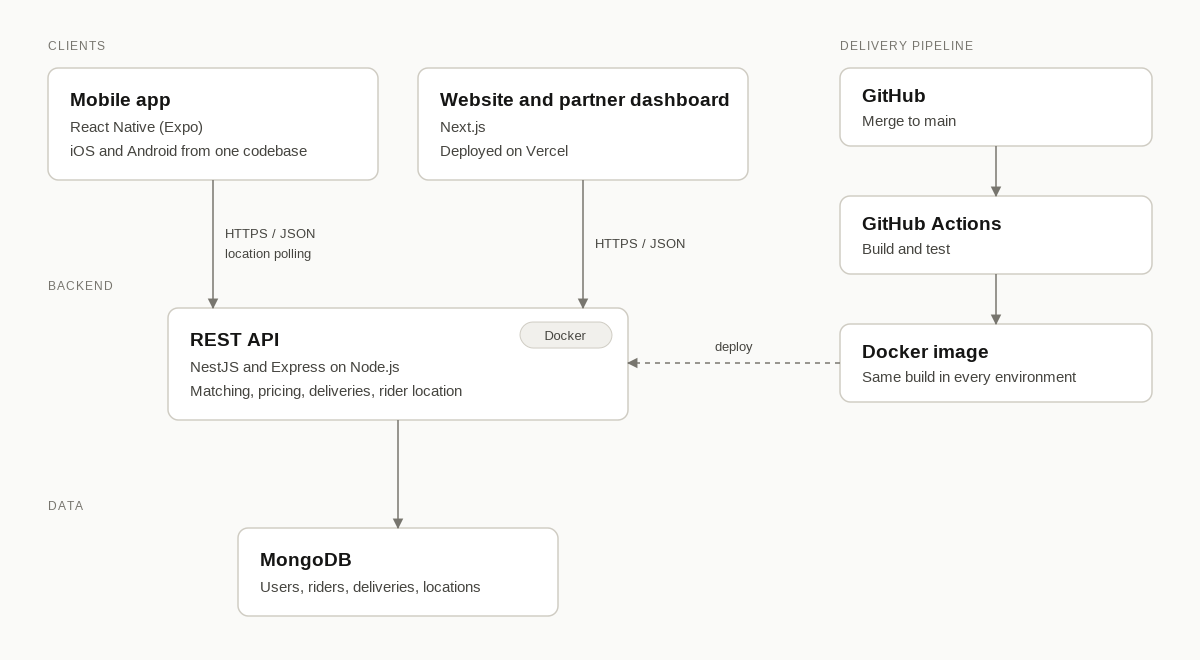
- Two clients, one API: the Expo mobile app and the Next.js web app both talk to the same NestJS/Express REST API over HTTPS.
- The API runs as a Docker container, so local, staging and production use the same build. The web app deploys on Vercel.
- GitHub Actions builds and tests on every merge, then ships the new image — no manual release steps.
Decisions
Polling instead of WebSockets for live tracking
Rider location reaches the customer by polling the API, not over a persistent socket. Polling is simple to build and debug, survives the patchy mobile networks riders work on without reconnection logic, and keeps the API stateless so it is easy to run in a container. The trade-off is that the map is a few seconds behind and every open tracking screen costs repeated requests — acceptable at current volume, and the first thing to revisit as usage grows.
One mobile codebase with Expo
A small founding team cannot maintain separate Swift and Kotlin apps. React Native with Expo gave us iOS and Android from one TypeScript codebase and the same language as the web app and API. The trade-off is less control over native modules, which matters most for location tracking — the part of the app that needed the most care.